The way we buy online is about to change at the protocol level. Google’s Universal Commerce Protocol (UCP) is being pitched as the first universal language for AI agents and commerce systems to talk to one another, enabling product discovery, carts, payment, and fulfillment in a seamless, machine-readable flow. This standard could be the infrastructure that finally lets AI agents act as full-fledged shoppers on behalf of users.
The Bottleneck Nobody Wanted to Own
E-commerce expanded through integrations. Each marketplace introduced its own APIs, checkout rules, and logic, making every new channel an engineering project with ongoing maintenance.
AI entered the scene as the decision layer. It could recommend, compare, and shortlist products. The transaction layer, however, stayed built around human processes. Protocols lacked a neutral way for agents to complete purchases across stores without custom work.
Commerce became the slowest part of the AI journey. Discovery advanced, but execution remained locked in fragmented systems, which UCP now defines for machine agents.
What the Universal Commerce Protocol Does
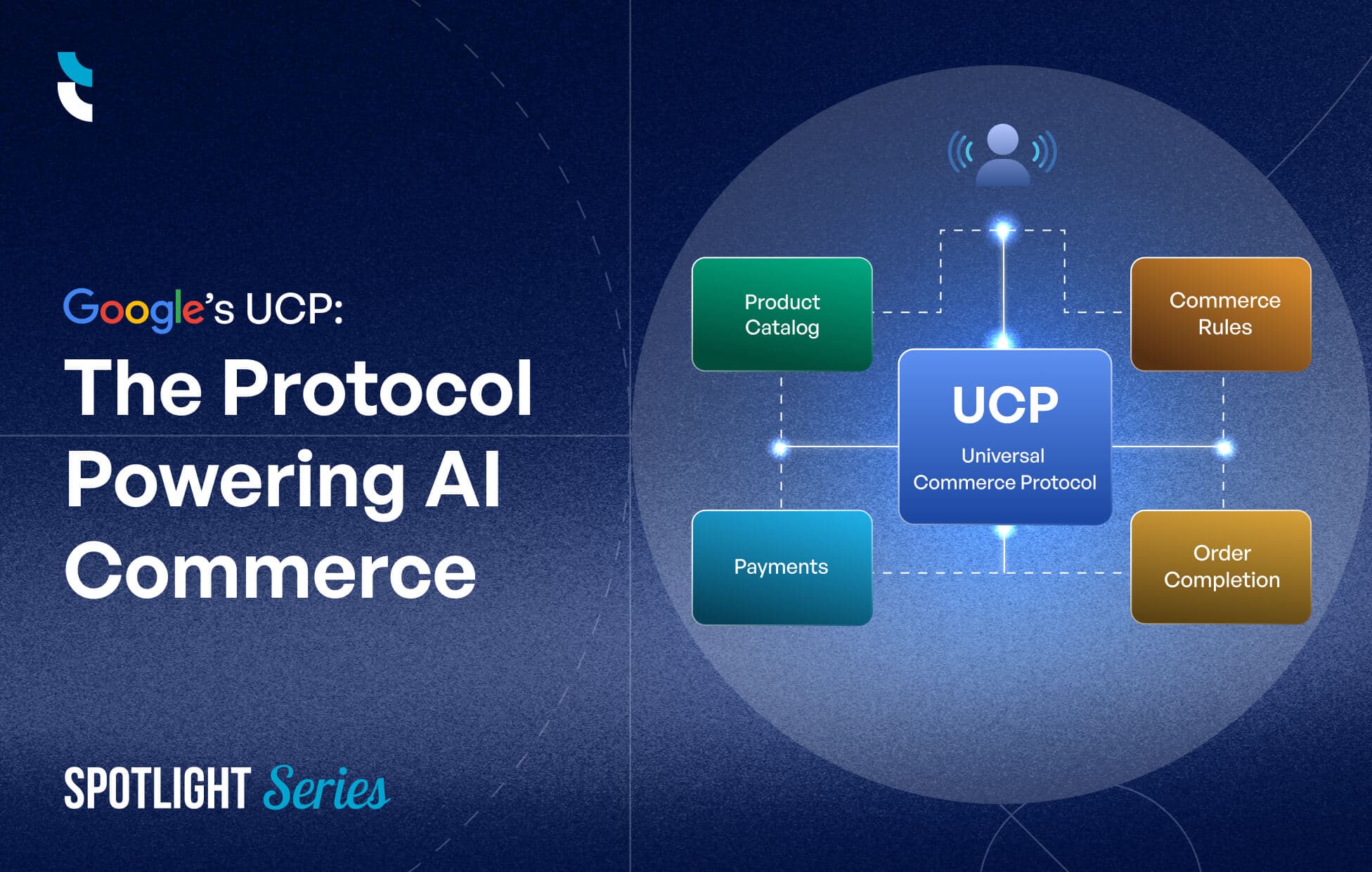
UCP defines a unified commerce stack that spans the full buying journey:
A catalog machines can read
AI agents access structured manifests for products, pricing, availability, and rules through standardized APIs. No scraping. No fragile connectors. Data arrives clean, consistent, and decision-ready.
Checkout logic without the maze
Cart rules, promotions, taxes, and loyalty live as machine-readable logic. Agents build carts that match real merchant policies without navigating interfaces designed for people.
Payments built for agents
UCP stays payment-agnostic. It separates instruments from handlers, allowing wallets and processors to plug in with flexibility. OAuth 2.0, AP2, and tokenized flows handle consent and credentials without exposing sensitive data.
Orders that stay in sync
Confirmations, tracking, returns, and updates flow through webhooks and status events. Agents manage the full lifecycle while merchants keep operational control.
In plain terms, UCP removes the handoffs that slow digital commerce. Agents transact end-to-end. Businesses keep their rules intact.
What UCP Sets in Motion
Though UCP is just rolling out, its design and broad backing suggest wholesale change:
Backed by the right crowd
Built with Shopify, Walmart, Etsy, Target, Wayfair and supported by Visa, Mastercard, PayPal, Stripe and others. A protocol gains power when competitors agree on the same grammar.
AI as the Buyer
Search engines, voice assistants, and chat platforms gain a shared way to discover, compare, pay, and manage orders without merchant-by-merchant builds.
Designed for an Open Ecosystem
Designed alongside A2A, AP2, and MCP, UCP fits into a wider agent ecosystem. New verticals and payment models plug into the same foundation.
Control stays with merchants
Pricing, inventory, fulfillment, and customer relationships remain business-owned. Agents execute rules. They do not rewrite them.
UCP’s promise is not just technical elegance - it represents the plumbing that could make AI agents true commerce participants instead of contextual assistants.
TRU Tie-In
At TRU, we believe that open, interoperable standards are the backbone of major digital shifts, just as APIs once enabled mobile commerce, protocols like UCP could enable AI-driven commerce at scale. Our work helps brands and platforms:
Assess where protocol readiness intersects with business strategy, evaluating whether agentic commerce should sit alongside traditional channels.
Design and test universal checkout integrations that comply with protocols like UCP and ACP without fragmenting operational workflows.
Build future-proofed commerce systems that can work with AI agents, marketplaces, and third-party intermediaries without bespoke engineering for each channel.
Define metrics and KPIs that reflect AI-mediated discovery and conversion, not just webpage hits or add-to-cart events.
UCP fits TRU’s view of commerce that works across platforms, respects business logic, and meets customers wherever interaction happens.
If AI agents could handle the entire shopping journey, from discovery to checkout, using a common protocol like UCP, what part of the experience do you think businesses will need to rethink first: product discovery, pricing & promotions, fulfillment logistics, or customer trust & consent, and why?