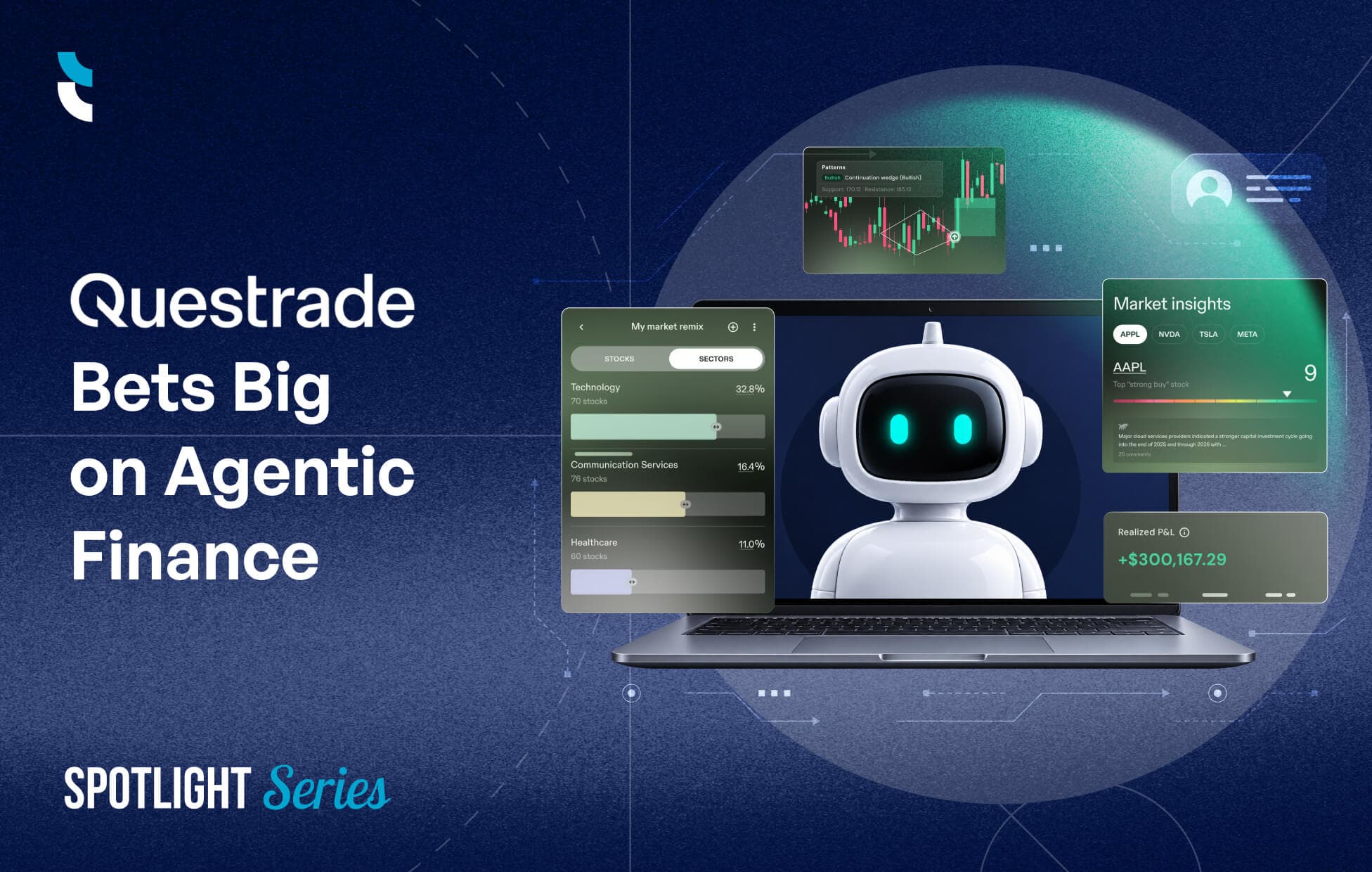
Questrade is making it possible for Canadians to hand a slice of their investing process to AI. With new tools connecting investment accounts to assistants like Claude and ChatGPT, and automation capabilities designed to execute user-defined strategies, the launch pushes agentic AI deeper into retail investing.
But it also raises a bigger question: how much responsibility should AI have when real money is involved? Questrade’s update offers a closer look at what happens when AI moves beyond research and recommendations into financial action. Here’s what Questrade actually launched, what it signals for the broader financial industry, and where trust, control, and human oversight enter the equation.
Inside Questrade’s AI Push: What Actually Changed
Questrade’s AI push comes down to two products: MCP and Flows.
Through Questrade MCP, clients can view and analyze account information, research potential opportunities using market data, and instruct an AI platform to initiate an order on their behalf (Fintech.ca).
Flows, which Questrade describes as Canada's first native financial automation engine, works the other direction: a client describes an investment strategy in plain language, and the platform builds and runs the automation, including executing trades on the client's behalf.
Together, the two offerings move Questrade beyond AI-powered research toward systems capable of helping investors initiate and carry out financial actions. The broader update also includes the elimination of per-contract fees on U.S.-listed equity options and coming-soon pre-IPO access for accredited investors. MCP and Flows, however, sit at the centre of Questrade’s push into agentic finance.
How AI Is Changing the Financial Landscape
Questrade may be the story here, but the shift is much bigger than one brokerage. Across financial services, AI is moving from a productivity tool on the sidelines to something increasingly embedded in how research happens, operations run, and financial decisions move forward.
From Research Reports to Instant Answers
Financial research used to mean opening reports, scanning market data, comparing sources, and piecing the story together. AI is compressing that process by extracting information from financial documents, summarizing research, surfacing patterns, and helping investors and analysts work through large volumes of data using natural-language questions.
The bigger change is how people access financial information. Instead of navigating multiple reports and platforms, users can increasingly ask for what they need and move from information to decision faster.
The End of the Manual Handoff
Some of the biggest changes are happening behind the scenes. Financial institutions are bringing AI into operational workflows, risk management, fraud and financial-crime prevention, customer service, and internal analysis.
The opportunity goes beyond saving time on individual tasks. More steps can be connected across teams and systems, reducing repetitive work and changing how financial operations move from one decision to the next.
The Moment Financial AI Takes Action
This is where Questrade becomes particularly interesting. Financial AI is moving beyond explaining markets and supporting research toward initiating actions based on user instructions and predefined conditions.
The move from insight to execution raises the stakes considerably. Once a system can influence or initiate what happens next, permissions, confirmation, traceability, and human oversight become part of the product itself. In financial services, trust is no longer just about whether AI gives the right answer. It is about whether users can understand, control, and verify what happens next.
Where Tru Sees This Going
This is the same tension we help clients navigate whenever AI moves from advising to acting: the technology is ready before the trust and governance around it are. Tru's AI Strategy Council exists for this reason — to make sure AI adoption comes with clear ownership, defined guardrails, and a hard line between what AI recommends and what a human confirms. Whether it's a brokerage wiring trade execution to a chatbot or a brand automating customer decisions, the deployment that wins isn't the fastest one — it's the one with confirmation steps built in from day one. That's the same discipline behind our AI services work: pairing capability with guardrails before either goes live.