A CMO types a question into an AI search tool. Within seconds, a clean summary appears. Three vendors are referenced and gain visibility.
This split-second selection now determines whether your brand captures attention.
Many brands rank on Google. Yet they never appear in the AI response.
This is the new reality of search. AI systems filter, summarize, and select which brands deserve mention. Visibility depends on inclusion inside the answer itself and at the exact moment a buyer is forming an opinion.
Answer Engine Optimization is the discipline built for this reality.
What Is Answer Engine Optimization
Answer Engine Optimization positions your content to be selected as a trusted response inside AI-driven search tools, including AI overviews and other answer-based search experiences.
Traditional SEO prioritized ranking positions.
AEO prioritizes citation and inclusion within generated answers.
When an executive types a complex question such as platform fit, compliance risk, or implementation criteria, AI systems scan for content that is structured, authoritative, and precise. Pages that follow the best AEO practices are far more likely to be referenced.
AEO aligns your content with how AI retrieves, evaluates, and summarizes information.
Why AEO Is Now Critical for B2B Visibility
B2B buying journeys are layered, political, and research-heavy. Committees evaluate vendors, question risk, and demand clarity at speed. AI tools now condense that entire process into sharp, shareable summaries that circulate across teams in minutes.
AEO strengthens visibility at three high-stakes moments:
Problem Framing: Buyers define the problem and choose which types of solutions are worth exploring.
Vendor Comparison: Buyers compare providers directly and narrow the list to a serious few.
Stakeholder Alignment: Teams discuss findings internally and decide which names move forward.
Brands cited in AI answers gain quiet authority. Brands missing from those answers start the race a step late.
6 Strategic Best Practices for Answer Engine Optimization
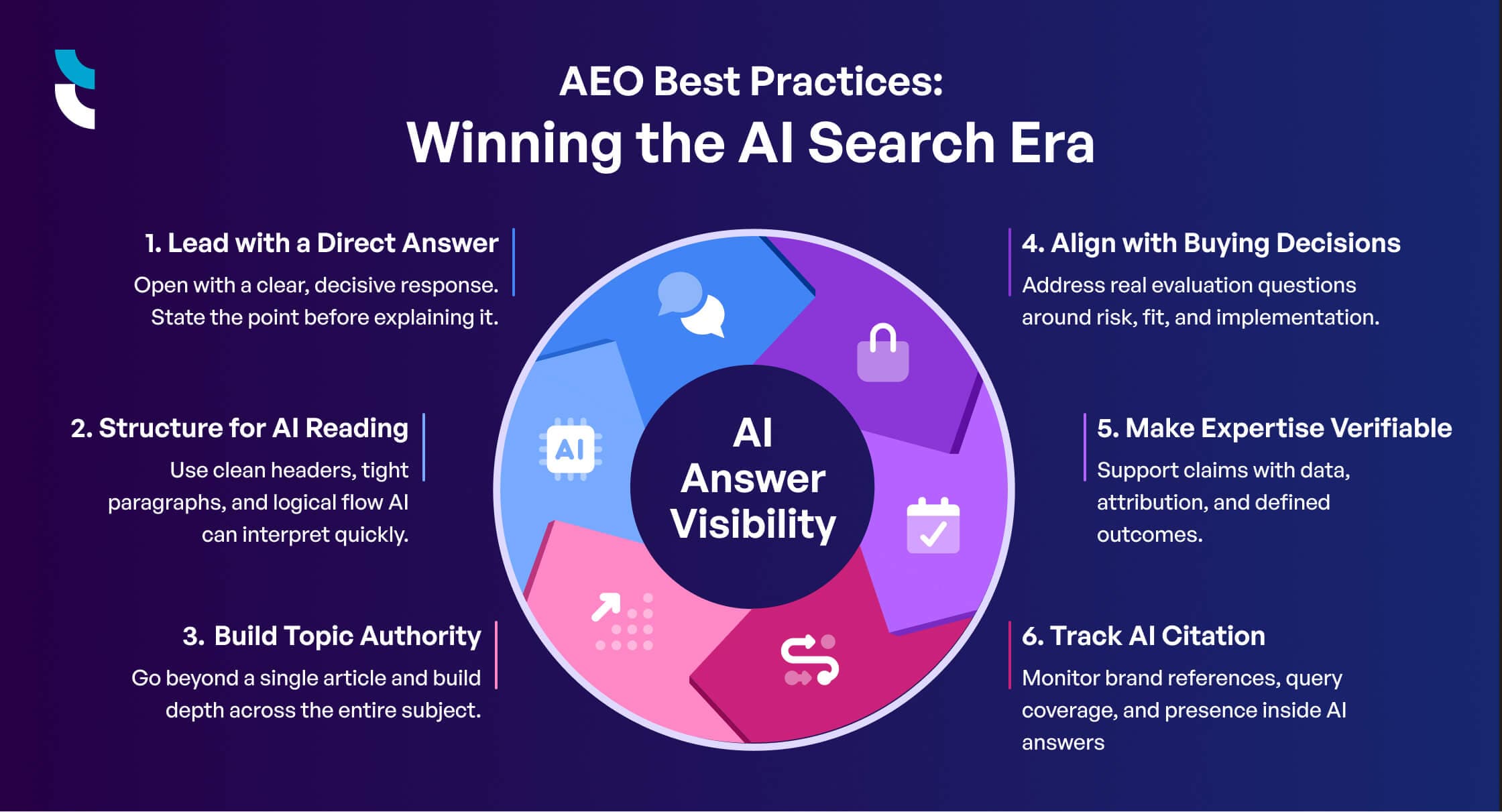
1. Stop Writing for Rankings. Start Writing for Selection.
Ranking first still matters. Selection inside an AI-generated answer carries strategic weight during evaluation.
AI systems reward clarity. To optimize AEO content, follow this disciplined pattern:
1. Open with a direct, concise response
2. Expand with context and supporting evidence
3. Reinforce with applied examples or proof points
Consider two articles defining agentic commerce.
One begins with a broad industry narrative. The other defines the concept in two precise sentences, outlines use cases, and includes a short enterprise scenario. AI systems gravitate toward the second structure because it mirrors how they synthesize information.
Write with extraction in mind. Direct answers increase citation probability.
Discover how Tru delivers advanced AEO services through a structured AI Search Optimization strategy.
2. Engineer Content for AI Retrieval
Structure signals credibility to both executives and machines.
AI engines rely on semantic cues such as headers, logical sequencing, and focused paragraphs to interpret meaning accurately. Dense blocks of copy reduce interpretability. Clean formatting improves comprehension.
Effective retrieval design includes concise headers aligned to search intent, tight paragraphs centered on a single idea, and occasional numbered frameworks with process clarity.
When content is engineered with intent and structure, citation frequency increases naturally. Clarity functions as a technical advantage expressed through writing.
3. Build Authority Across an Entire Topic
Single articles rarely establish durable authority. AI systems assess breadth and depth across a subject area.
Topical authority compounds through connected assets that address foundational definitions, industry applications, governance considerations, and implementation pathways. Internal linking reinforces consistency and strengthens semantic relationships.
A buyer researching AI governance evaluates credibility through depth. A single overview page feels surface-level, while a strong network of detailed guides, case studies, and supporting content signals real hands-on experience and practical understanding.
4. Align with High-Intent Buyer Questions
AEO content mirrors how real buyers think. Their queries focus on applicability, risk, and evaluation criteria.
Best-performing AEO content aligns with questions such as:
How does this solution fit my specific industry or use case?
How does it compare to other available options?
What risks or limitations should I consider?
Specific, experience-backed responses resonate strongly with AI summarization models. Broad, generic messaging gets overlooked.
Precision reflects expertise, and expertise makes a brand more likely to be chosen.
5. Make Expertise Verifiable and Machine Readable
AI systems prefer content supported by proof. Authority must be visible and structured.
Use this checklist to strengthen your brand credibility:
Include cited research from trusted, relevant sources
Feature named authors with strong domain expertise
Add dates to insights to demonstrate relevance
Define case outcomes with quantified results
Provide structured summaries highlighting key takeaways
Add an FAQ section to improve extraction efficiency
When expertise is structured and provable, both machines and buyers choose you.
6. Measure Visibility Inside AI Answers
Traditional SEO metrics emphasize traffic and keyword ranking. AEO performance requires broader evaluation.
Advanced teams review brand mentions within AI tools, assess coverage across priority buyer questions, and benchmark citation presence against competitors.
Presence inside AI-generated answers reflects influence during authentic research behavior. Absence indicates missed opportunity, even when rankings appear strong.
Own the First Mention
Answer Engine Optimization determines whether your brand appears in that first layer of credibility. Structured thinking, precise language, and verifiable expertise increase the likelihood of citation at the exact moment buyers are forming opinions.
Ranking may place you on a page. Selection places you inside the answer.
In high-stakes B2B decisions, the brand mentioned first often frames the entire discussion. Earn that position.
Frequently Asked Questions about AEO
Answer Engine Optimization (AEO) is the process of structuring content so it is selected and cited inside AI-generated search answers.
It focuses on providing clear, direct responses, strong content structure, topical authority, and proven expertise so AI systems can retrieve and summarize the information accurately.
AEO focuses on earning citations inside AI-generated answers, while traditional SEO focuses on ranking web pages in search results.
SEO improves visibility through keyword targeting and technical optimization. AEO improves visibility by delivering structured, concise answers that AI tools can extract and reference during user queries.
AEO is not replacing traditional SEO, but it is expanding it.
SEO focuses on ranking web pages, while AEO focuses on earning citations inside AI-generated answers. Modern search strategies integrate both approaches to maintain visibility across traditional and AI-driven search environments.
Businesses can improve AI search visibility by leading with direct answers, using structured formatting, building topic authority, and supporting claims with credible evidence. AI systems prioritize concise definitions, clear headers, semantic depth, and authoritative signals when selecting content for summarization.
Answer Engine Optimization uses a combination of SEO platforms, structured data tools, content analysis software, and AI citation monitoring solutions. These tools help improve content structure, implement schema markup, monitor brand mentions in AI-generated answers, and measure visibility across AI overviews and generative search platforms.